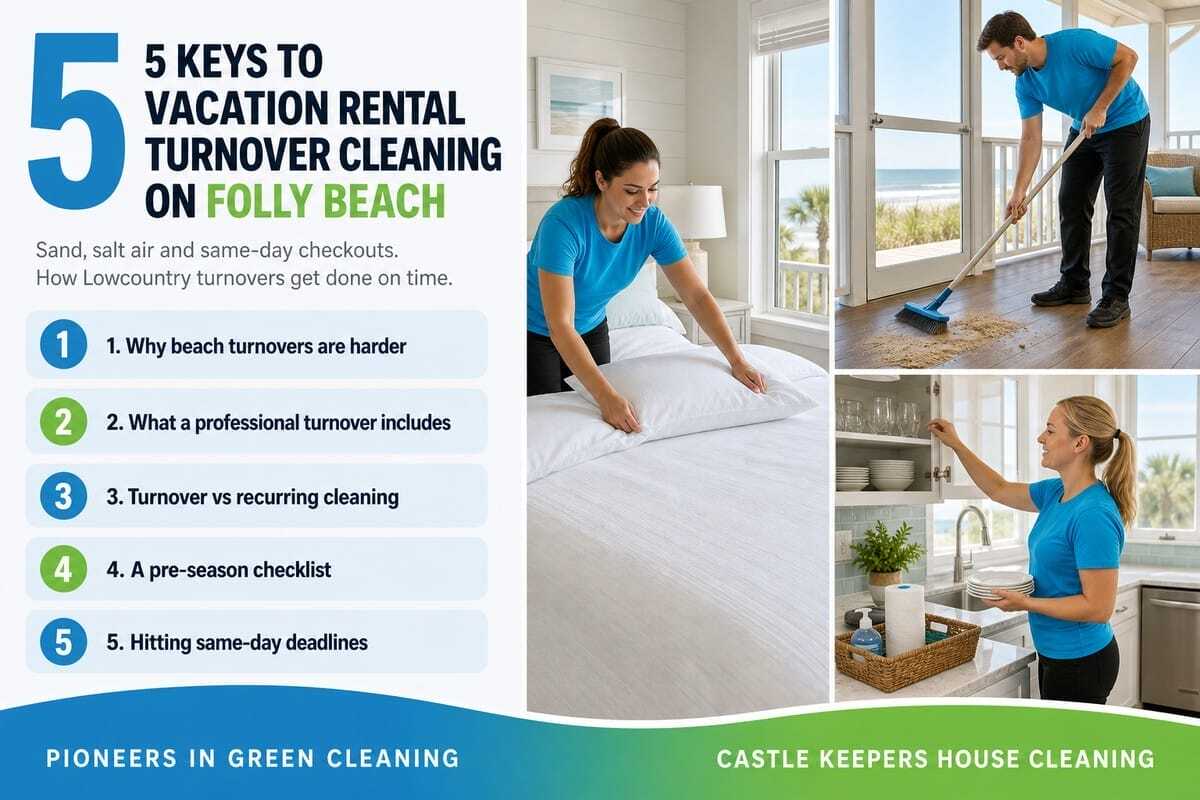
Vacation Rental Turnover Cleaning on Folly Beach
- Turnover cleaning is a distinct discipline: prioritize inspection, inventory, documentation, and a fixed reset standard to meet guest expectations on Folly Beach.
- Sand, salt, and humidity demand specific steps: dry soil first, dissolve salt films, squeegee showers, run HVAC to dehumidify per EPA guidance.
- Fixed 10 a.m. to 4 p.m. turnover window needs route density, on-site laundry or backup linen sets, consistent teams, and real-time host communication.
A Folly Beach rental turns over on a Saturday morning with a hard deadline: guests check out at 10, new guests arrive at 4, and everything in between has to be spotless, restocked, photographed, and reported. Add salt air, sand in every corner, and a summer week where every home on the island turns over the same day, and you have one of the most demanding cleaning jobs in the Lowcountry.
Vacation rental turnover cleaning is not residential housekeeping done faster. It is a different discipline with different priorities — inspection, inventory, and documentation matter as much as the cleaning itself. Here is how professional turnovers actually work on Folly, and what island hosts should expect from a turnover program.
Why Vacation Rental Turnover Cleaning on Folly Beach Is Harder
Coastal rentals fail cleanliness reviews for reasons that have almost nothing to do with effort. They fail because of conditions specific to a barrier island:
- Sand migrates. It collects in door tracks, stair nosings, sofa seams, under bed rails, and inside the washer gasket. Sand that gets damp-mopped becomes grit that scratches floors. Correct order matters: dry removal first — vacuum with a crevice tool and brush — then damp cleaning.
- Salt air leaves film. Airborne salt settles on windows, sliders, mirrors, stainless appliances, and outdoor furniture, then attracts moisture and hazes over. It needs to be dissolved and removed, not buffed around with a dry cloth. Salt also accelerates corrosion on hardware and fixtures, so hinges, locks, and shower valves need routine attention.
- Humidity works against you. Charleston County summer humidity commonly sits high enough that a bathroom closed up after cleaning will hold moisture for hours. That is how musty smells and mildew on grout and silicone caulk start — usually the number one complaint in coastal rental reviews.
- The window is fixed. Most Folly Beach and James Island rentals share the same 10 a.m. to 4 p.m. turnover slot, and a delay cascades directly into a guest arriving to an unfinished home.
- Sun, sunscreen, and beach gear. Sunscreen leaves an oily residue on light switches, remotes, door handles, and vinyl furniture that ordinary all-purpose cleaner smears rather than lifts.
The Mildew Problem — and the Fix
Mildew on caulk and grout is a moisture problem, not a dirt problem. Bleach-based products lighten the stain but do nothing about the conditions, so it returns within weeks. The professional approach is threefold: remove the biological film with an appropriate cleaner and contact time, dry the surface completely, and then control humidity between guests. The EPA’s mold guidance is blunt about the underlying principle — without moisture control, cleaning alone will not hold.
Practically, on Folly that means: squeegee or towel shower walls and glass at the end of the clean, leave bathroom doors open and exhaust fans running through the final walkthrough, and keep the HVAC running with a set point that continues to dehumidify while the home sits vacant. Homes shut down completely between bookings to save a few dollars on power almost always develop odor complaints.
What a Professional Turnover Actually Includes
A turnover clean has a sequence, and skipping steps is what produces bad reviews. The core workflow:
- Damage and inventory inspection first. Before anything is touched, the home is walked and documented — stains, breakage, missing items, appliance issues. Once cleaning starts, evidence disappears. This inspection is what protects a host’s damage claim.
- Strip and start laundry immediately. Linens and towels go in first so drying time runs in parallel with the rest of the clean, not after it. Sand shakes out of beach towels before they ever reach the washer.
- Trash, recycling, and abandoned food. Refrigerators are emptied, not just wiped — leftover food is the most common cause of an odor complaint on arrival.
- Dry soil removal, high to low. Ceiling fans, sills, blinds, and upholstery vacuumed; sand extracted from tracks, seams, and stair edges.
- Kitchen reset. Interior of microwave and refrigerator, cooktop, coffee maker, dishwasher emptied, cookware verified clean and put back in the same place every time.
- Bathrooms with contact time. Disinfectants left wet for the labeled dwell time, glass descaled, drains cleared of hair, then everything dried.
- Restock and staging. Paper goods, soap, coffee, dish and laundry detergent, trash liners; beds made to a consistent standard; furniture and decor returned to the same layout the listing photos show.
- Final floors, then a photo report. Floors are last. Then room-by-room photos and a written report so the host knows the home was left guest-ready — and has proof if a guest claims otherwise.
The Restock and Inventory Layer Hosts Underestimate
Guests judge readiness by details a housekeeper has to be told to track: enough toilet paper for the full stay, matching towel counts per bedroom, working remotes, beach chairs and umbrellas present and rinsed, grill cleaned, outdoor shower functional, and the sand bucket by the door. A turnover program without a written par-level inventory list will fail on these eventually, because nobody can remember 40 consumables across multiple properties. A documented, home-specific list is the difference between a five-star arrival and a 9 p.m. text from a guest about missing towels.
Turnover Cleaning vs. Recurring Home Cleaning
Hosts sometimes assume any cleaning company can absorb turnovers. The differences are worth knowing before you hire:
- Scheduling is date-driven, not interval-driven. Turnovers follow the booking calendar, including back-to-back same-day changeovers and holiday weekends.
- Reset standard, not maintenance standard. Every visit must return the home to an identical baseline, because the next guest has never seen it before and has photos to compare against.
- Reporting is part of the deliverable. Damage documentation, maintenance flags, and consumable levels are reported to the host, not just cleaned around.
- Deep cleaning still has to happen. Turnovers cannot substitute for periodic deep work. Coastal rentals generally need a scheduled deep clean — inside cabinets and appliances, upholstery, grout, window interiors, HVAC vents — at least twice a year, ideally before peak season and again after it.
When a Host Can Handle It Alone
Honest answer: if you own one property, live nearby on Folly or in West Ashley, and rent it a handful of weekends a year, self-managing turnovers is very doable and saves real money. The economics change when bookings become continuous, when you cannot physically be on the island for every changeover, or when a single missed turnover threatens a superhost rating. At that point the cost of professional turnovers is cheap compared to one bad cleanliness review, which follows a listing for months.
A Practical Pre-Season Checklist for Folly Beach Rentals
- Replace or professionally clean HVAC filters monthly during peak humidity; a loaded filter kills dehumidification.
- Re-caulk any shower or tub silicone that is stained rather than repeatedly bleaching it.
- Rinse salt from window hardware, sliders, and door locks and lubricate tracks so sliders don’t seize mid-season.
- Check that the washer gasket and drum are clean and dry; run a cleaning cycle before the season starts.
- Standardize linens so counts and replacements are simple, and keep one full backup set on site.
- Photograph every room at the standard staging layout and give the photos to your cleaning team as the reset reference.
How Same-Day Turnovers Get Done on Time
The operational side is where turnover programs succeed or fail. A crew that cleans beautifully but arrives at 2:30 for a 4 p.m. check-in is not a viable partner during peak season. Three things make the timeline hold:
- Route density. Teams working several properties in the same area — Folly, James Island, the connector corridor — lose far less time to bridge and beach traffic than a crew driving in from across the county for a single stop. On summer Saturdays, Center Street and the Folly Road approach can add 30 minutes with no warning, so routing is a real quality factor.
- Laundry strategy. On-site laundry ties the whole turnover to one washer and dryer cycle. Properties with heavy back-to-back bookings usually do better with a second linen set staged on site, so the clean set goes on the bed immediately and the used set is washed in the remaining time or taken off site.
- A fixed task sequence. When the same team follows the same order in the same home every visit, the clean gets faster without getting thinner. This is the practical reason we assign consistent teams rather than rotating whoever is available — familiarity with a specific property is what buys back the minutes.
Communication is the fourth piece. A host needs to know when the team arrives, when the home is guest-ready, and immediately if something is wrong — a broken slider lock, a leaking supply line under a sink, a stain that will not release. Finding out at 4:05 p.m. from a guest is not an option, which is why real-time notifications and a written post-visit report matter more in rental work than almost anywhere else in residential cleaning.
Talk to a Lowcountry Cleaning Team That Documents Its Work
Castle Keepers House Cleaning has cleaned Lowcountry homes since 1994, and the systems our recurring clients value — home-specific detailed scopes of work, the same assigned team, post-visit scorecards, real-time notifications, and an online customer portal — are exactly what a rental turnover program needs. Our staff is insured, bonded, and background-checked, and we use green cleaning methods that are safer for guests, pets, and coastal interiors.
We serve Folly Beach along with Sullivan’s Island, Isle of Palms, and the wider Charleston area. If you manage a coastal rental and want a turnover process that holds up in August, reach out for a walkthrough and a written scope built around your property and your booking calendar.
Share this article
Related Posts






A quick overview of the topics covered in this article.