What House Cleaning Costs in Charleston, SC
- Expect variable pricing; professional single-family visits commonly cost $120 to $250, Charleston often lands higher due to local labor and climate.
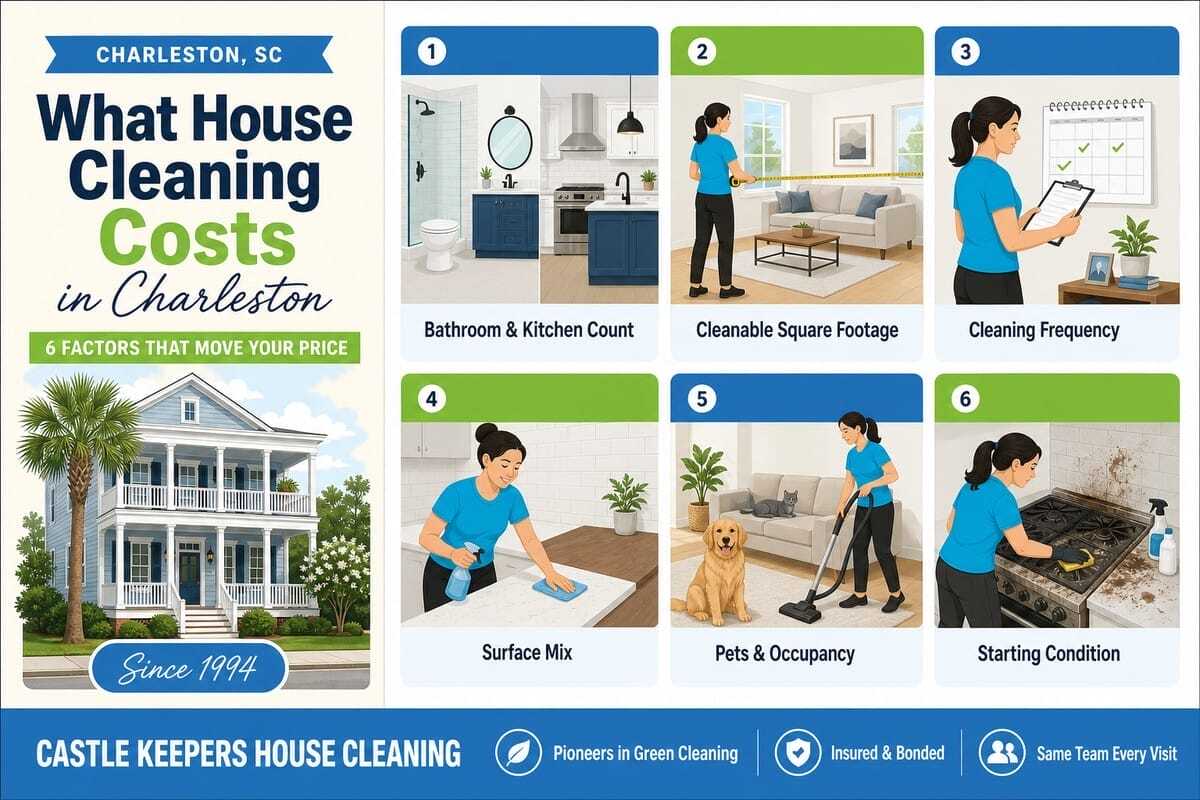
- Price driven mainly by bathroom and kitchen count, cleanable square footage, frequency, surface mix, occupancy, pets, and starting condition.
- Charleston's humidity, salt air, pollen, and historic building materials increase labor and specialty cleaning, raising recurring service costs.
- A fair recurring price includes a written room-by-room scope, the same trained team, liability and workers' compensation insurance, and background-checked employees.
Ask five Charleston cleaning companies what a house cleaning costs and you will get five different answers — an hourly rate, a flat “standard clean” price, a per-square-foot estimate, and at least one “we’d need to see it first.” None of them are necessarily wrong. They are simply pricing different things.
Castle Keepers House Cleaning has been cleaning homes on the peninsula, across the Ashley and Cooper, and out toward Summerville since 1994. In that time we have learned that homeowners shopping for recurring service are almost never looking for the cheapest number. They are trying to work out whether a number is honest — and whether it will still be the number in month four. This guide breaks down what actually drives house cleaning cost in Charleston, SC, what a fair quote includes, and where the low bids quietly fall apart.
What House Cleaning Costs in Charleston, SC: Real Ranges
Castle Keepers does not publish a flat price list, and we will explain why below. But you deserve a number to anchor against, so here is the honest landscape.
National cost surveys from home-services marketplaces such as Angi and HomeAdvisor consistently place a professional single-family cleaning visit in the $120–$250 range, or roughly $0.10–$0.20 per square foot, with deep cleans and first-time resets landing 1.5x to 2x higher than an ongoing maintenance visit. In the Charleston market, recurring service for a typical 2,000–2,500 sq ft home with two to three bathrooms tends to sit in the middle-to-upper part of that band, because labor costs here have risen faster than the national average and because our climate adds work that inland markets simply do not have.
Treat those figures as a sanity check, not a quote. A quote that comes in dramatically below that band in downtown Charleston is usually not a bargain — it is a signal that something (insurance, payroll taxes, screening, or scope) has been removed to make the number fit.
The Six Factors That Actually Move Your Price
When we scope a home in Mount Pleasant, West Ashley, or South of Broad, these are the variables that change the number — in roughly the order of how much they matter:
- Bathroom and kitchen count. These two rooms carry the most labor per square foot of anything in your house. Disinfectants need dwell time to work, fixtures need detail work, and glass needs drying to avoid spotting. A four-bath home is meaningfully more work than a two-bath home of identical size.
- Cleanable square footage, not total square footage. A finished bonus room nobody uses is not the same as a busy kitchen of equal size. Ask whether the quote is priced on rooms actually serviced.
- Frequency. Weekly and bi-weekly visits cost less per visit than monthly ones, because soil never gets a chance to build. In Charleston, monthly service means four weeks of humidity, salt air, and pollen doing their work before anyone touches it.
- Surface mix. Original heart pine floors in a Radcliffeborough single house, unsealed marble in a Daniel Island primary bath, glass shower enclosures fighting hard water, and painted historic millwork all require different chemistry and different technique. Delicate surfaces take longer to clean correctly, and correctly is the only way worth paying for.
- Occupancy and pets. Two adults who travel for work generate a fraction of the soil load of a family of five with two dogs and a beach habit. Sand is abrasive and it migrates; it is a real line item in a coastal market.
- Starting condition. If a home hasn’t had professional attention in a year, the first visit is a reset, not maintenance. Honest companies price that first visit separately instead of pretending recurring rates apply to it.
Why Charleston Costs More Than the Upstate
Homeowners who moved here from Greenville or Columbia often notice the difference, and it is not imaginary. Charleston’s subtropical climate creates cleaning work that dry markets do not have:
- Humidity. The U.S. EPA notes that mold growth becomes likely when indoor relative humidity stays above roughly 60% — a threshold Charleston summers cross routinely. That means bathroom grout, window sills, and closet corners need attention on a schedule, not opportunistically.
- Salt air and sand. Homes east of the Cooper and on the islands accumulate a fine salt film on glass and hardware, plus tracked-in sand that acts like sandpaper on finished floors.
- Pollen season. The Lowcountry’s late-winter and spring pollen load coats horizontal surfaces within days of a clean, which is a genuine argument for tighter frequency rather than a bigger single clean.
- Historic housing stock. Older downtown homes have plaster, original wood, and hardware that cannot take modern all-purpose chemistry. Slower, gentler work costs more per visit and protects a far more expensive asset.
Hourly vs. Flat Rate: Which Is Better for a Charleston Home?
Both models can be fair, and both can be abused.
Hourly pricing is transparent about time but silent about outcome. You are buying minutes, not a finished home. If the crew works slowly, you pay more; if they run out of time, the last rooms get skipped — and it is almost always the rooms at the end of the route. Hourly makes sense for open-ended projects where nobody can predict the scope in advance.
Flat-rate pricing attached to a written scope of work is usually the better arrangement for recurring residential service, because the risk of a slow day shifts to the company instead of to you. The critical word there is attached. A flat rate with no documented task list is just a number. A flat rate tied to a room-by-room, task-by-task scope is a commitment.
That is why every Castle Keepers client gets a home-specific detailed scope of work: what happens every visit, what rotates on a schedule, and what is intentionally excluded. It removes the two most common sources of frustration in this industry — assuming something was included when it wasn’t, and paying for work you never actually wanted.
When You Should Not Hire a Cleaning Service
We would rather lose a quote than set up a client to be unhappy. Recurring professional cleaning is probably not the right spend if:
- You are looking for one clean before a party. A single deep clean is a legitimate purchase, but recurring pricing exists because maintenance is cheaper than resets. If you genuinely only want one visit a year, you are paying reset pricing every time.
- Your household already cleans weekly and enjoys it. If the kitchen and baths get real attention every week, a service will maintain what you already have — which is fine, but it is a time purchase, not a quality upgrade.
- Your budget only stretches to monthly. Monthly service in this climate often disappoints, because four weeks of Charleston humidity and pollen outruns a maintenance visit. Bi-weekly at a smaller scope usually delivers a better-feeling home for similar annual spend.
- You need construction or post-renovation cleanup. That is specialized work with different equipment and different risk. Hire a company that does it every day.
Red Flags in a Cheap Charleston Quote
Before you compare prices, compare what sits behind them:
- No liability insurance or bonding. Ask for a certificate, not a verbal assurance. Damage to a historic floor is not a small claim.
- No workers’ compensation coverage. If a cleaner is injured in your home and the company carries none, that claim can land on your homeowners policy.
- No background screening. You are handing over access to your home. Screening costs money, and that cost lives inside a fair price.
- Rotating strangers. Companies competing purely on price tend to have high turnover, which means someone new learning your home every visit. Consistency is not a luxury — it is the mechanism that makes quality repeatable.
- Cash-only, no written agreement. No paper trail means no recourse.
What a Fair Price Should Buy You
At the price point described above, a professional recurring clean in Charleston should include a documented scope, the same trained team on the same day, insured and background-checked employees (not day-labor subcontractors), and a way to tell someone when something isn’t right. Our clients get an automated scorecard after every visit and access to an online customer portal with real-time notifications, so quality is something you can see rather than something you have to chase. As green cleaning pioneers who co-authored the industry’s Healthy Cleaning & Techniques certification manual, we also use products chosen for indoor air quality — which matters more, not less, in a market where the windows stay shut for months.
Getting an Accurate Number for Your Home
The fastest way to replace a range with a real figure is to let us scope your actual home rather than a hypothetical one. You can compare our approach on our house cleaning services page, see what we cover across the Lowcountry on our Charleston house cleaning page, or read about our green cleaning approach if indoor air quality is a priority. Moving rather than staying? Our Charleston move-in/move-out cleaning is priced differently and for good reason.
When you’re ready for a number instead of a range, request a quote and we’ll build it from your home, your surfaces, and the frequency that actually fits how you live.
Share this article
Related Posts





A quick overview of the topics covered in this article.