Hiring a Housekeeper in Greer, SC: Independent vs. Company
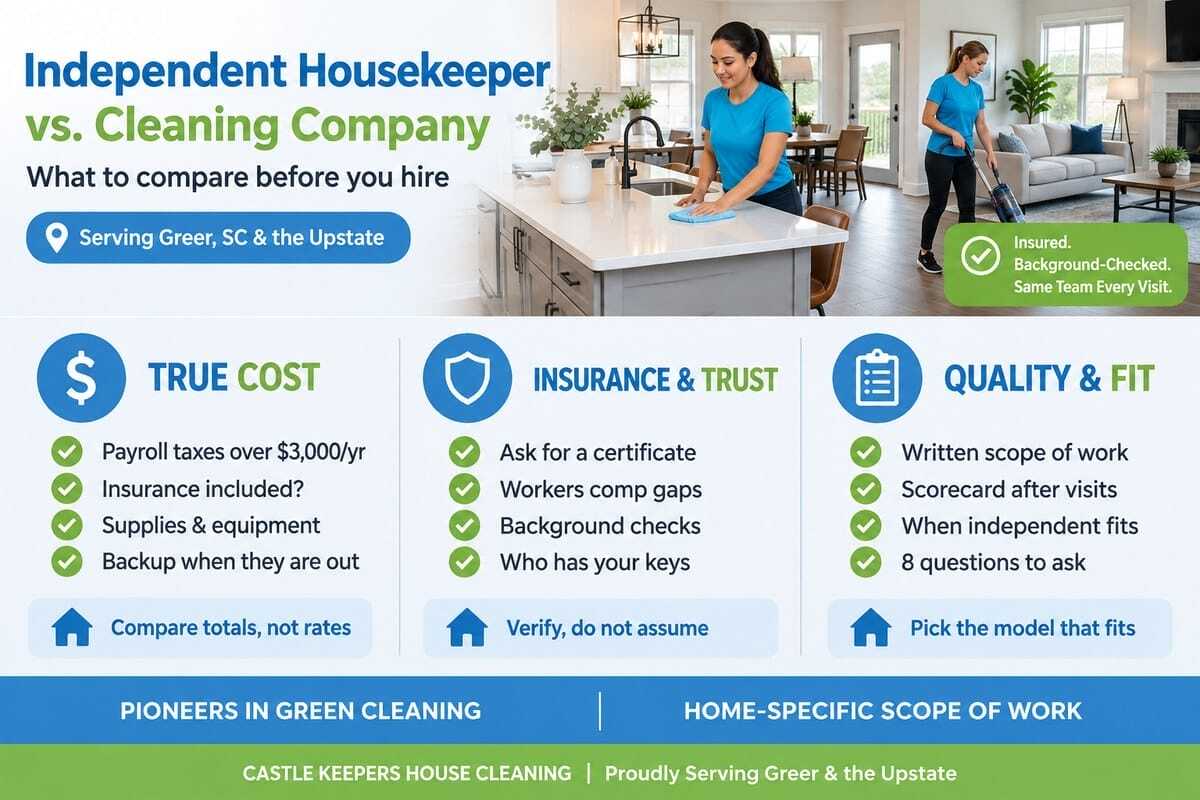
- In Greer, independents offer flexibility and lower rates; companies provide trained staff, scheduling, and a process behind the service.
- Insurance matters: companies include liability and bonding; independents often lack workers' comp. Call your agent and check South Carolina rules.
- Trust and access: companies use background-checked staff, managers, and key protocols; independents rely on personal referrals and informal arrangements.
- Compare total cost: include IRS payroll tax rules, supplies, insurance, and backup coverage, since company backups prevent missed cleans.
Search for a housekeeper in Greer and you’ll find two very different kinds of help. One is an individual: a neighbor’s longtime cleaner, someone from a community Facebook group, or a profile on a booking app. The other is a cleaning company with employees, insurance, a schedule, and an office you can call. Both can clean a house well. They are not the same purchase, though, and the differences show up in places most people don’t think about until something goes wrong.
Castle Keepers House Cleaning has served Upstate homes since 1994, so yes, we’re one of the options here. We’ll still try to give you a fair picture, including when an independent housekeeper is the better choice. Some households really are better served by one.
Hiring a Housekeeper in Greer: The Two Models
An independent housekeeper works for themselves. They set their own rate, bring (or don’t bring) their own supplies, and answer to you directly. Some are excellent and have kept the same clients for twenty years. Others are building a side income between other jobs.
A cleaning company employs the people who come into your home. The company trains them, schedules them, carries the insurance, handles payroll taxes, and is responsible for the result. You’re buying a service with a process behind it, not hiring one person.
There’s a third option you’ll run into on your phone: app-based marketplaces. They look like a company but often work more like a directory. The person who shows up may be an independent contractor, and who is responsible when something breaks can depend on the platform’s terms. Read those terms before your first booking.
Cost: What You’re Actually Comparing
Independent housekeepers often quote a lower hourly rate than companies. That’s real, and for some budgets it settles the question. Before you compare the two numbers, check what each one includes.
- Payroll taxes. If an individual cleans your home regularly and you control how and when the work is done, the IRS may consider that person your household employee rather than a contractor. For 2026, if you pay one household employee cash wages of $3,000 or more in the year, you generally have to withhold and pay Social Security and Medicare taxes, 7.65% from you and 7.65% from them. The IRS household employee guidance explains the rules. A biweekly cleaner can pass that threshold by early summer.
- Insurance. A company’s rate includes general liability insurance and bonding. An independent cleaner’s usually doesn’t.
- Supplies and equipment. Some independents ask you to supply products and the vacuum. That’s a real cost, and it means your vacuum takes the wear. Our Greer teams bring their own eco-friendly products, color-coded microfiber, and HEPA-filtration vacuums.
- Backup coverage. When an independent housekeeper is sick, on vacation, or moves away, the clean just doesn’t happen. A company sends someone else, and the price stays the same.
Comparing the hourly rate alone is like comparing two car prices without asking which one includes tires. Write down what each option actually covers, and the gap is often smaller than it first looks.
Insurance and Liability: The Question Most People Skip
This is the part that matters most, and it’s where the two models differ most.
In South Carolina, workers’ compensation generally isn’t required for employers with fewer than four employees (see the SC Workers’ Compensation Commission employer FAQ). In practice, an independent housekeeper working alone usually has no workers’ comp coverage. If they slip on a wet floor in your kitchen or hurt their back moving a sofa, the first policy anyone looks at may be your homeowners policy. Some policies cover domestic workers and some don’t. Call your agent before you hire, not after an accident.
Property damage is the other risk. Bleach on a rug, a scratched stone countertop, or a broken lamp all happen in houses that get cleaned often enough. A company with liability insurance has a process for this. With an independent cleaner, your options are usually their goodwill, your own deductible, or small-claims court.
Whoever you hire, ask for a certificate of insurance, not a verbal “yes, we’re insured.” Any legitimate company can email one the same day.
Trust, Keys, and Who Is in Your Home
Many Greer families work at BMW, at GSP, at the Inland Port, or at one of the dozens of manufacturers and suppliers around them, and plenty of those jobs run on shifts. That usually means the cleaning happens while nobody’s home, so you need to know who has your garage code.
With an independent housekeeper, trust is personal. You know them, maybe through a referral, and that relationship can be very good. The risk is that you rarely know who they bring along on a busy week, or whether anyone has checked their background.
With a reputable company, trust comes from the system. Employees are background-checked before they’re hired, they’re insured and bonded, and there’s a manager you can call. At Castle Keepers we also use same-team assignments, so the same small team comes to your home each time. You get to know a familiar face without giving up the company’s accountability.
App platforms vary. Some screen everyone who takes jobs and some only screen the business owner. If a strange car pulls into your driveway, you should know which kind you booked.
Consistency and Quality Control
A great independent housekeeper can clean with real care, because their name is on every job. When one person does the work, though, the quality of each visit depends on that person’s week.
A company replaces some of that personal pride with a system. At Castle Keepers that means:
- A home-specific detailed scope of work, written for your house, so “clean the bathrooms” means the same thing on every visit and to every team member.
- An automated scorecard after each clean, so you can see what was done and flag anything that wasn’t.
- An online customer portal with real-time notifications, so you aren’t texting someone’s personal cell to reschedule.
- Green cleaning methods and products that are the same every visit. We’ve used them since long before eco-friendly was a trend.
None of this makes a company automatically better. A badly run company with high staff turnover can be less consistent than a good independent who has cleaned the same house for a decade. Ask any company how long its teams typically stay together.
When an Independent Housekeeper Is the Better Choice
We’d rather lose a quote than set someone up with the wrong fit. An independent housekeeper may be the better choice if:
- You want flexible, mixed tasks. Laundry, folding, a grocery run, organizing a pantry, watching the dog. Many independents do a mix of household help that a cleaning company doesn’t offer.
- You’re comfortable being an employer. You’ll handle the tax paperwork if wages cross the threshold, you’ve confirmed your homeowners coverage, and you have a plan for weeks when they can’t come.
- You already have someone you trust. A cleaner your family has known for years and who comes with strong references is a real asset. Don’t replace them to save a little or to follow a trend.
- You need occasional help, not a schedule. If you want someone a few times a year, a recurring company relationship probably isn’t worth it.
When a Cleaning Company Makes More Sense
- You won’t be home during cleans and want background checks, insurance, and a manager behind whoever comes in.
- You need the clean to happen every time. Families with young kids, pets, allergies, or demanding work schedules usually can’t absorb a missed visit.
- You don’t want to be an employer. No payroll taxes, no year-end forms, no wondering about workers’ comp.
- You want a written standard. A detailed scope and a scorecard make the work something you can measure.
Questions to Ask Either Option Before You Hire
- Can you send a certificate of liability insurance? Are you bonded?
- Who exactly will be in my home, and has everyone had a background check?
- What happens if you’re sick or on vacation on my cleaning day?
- What’s included in a standard visit, and can I get that in writing?
- Do you bring your own supplies and equipment? What products do you use?
- What happens if something gets damaged?
- How do I reschedule, give feedback, or raise a problem?
- How long have your current clients been with you?
If you hear a confident, specific answer to all eight, from either an individual or a company, you’ve probably found good help.
Cleaning Homes in Greer and the Surrounding Upstate
Greer sits right on the line between Greenville and Spartanburg counties, and so does our service area. Our teams work across Greer, from the older homes near downtown and Trade Street to the newer subdivisions that went up alongside the city’s growth. They also cover neighboring Taylors and the rest of the Greenville area. Those newer builds tend to have open floor plans, lots of luxury vinyl plank flooring, and red Upstate clay tracked in from yards that are still filling in. Our Greer house cleaning page covers how we handle them.
If a company sounds like the right fit, our recurring house cleaning service starts with a walkthrough and a written scope of work built for your home. If you’d rather keep an independent housekeeper, we hope the questions above help you hire well. When you’re ready to compare, request a free quote. We’ll give you a straight answer about whether we’re the right fit.
Share this article
Related Posts




A quick overview of the topics covered in this article.