Apartment & Townhome Cleaning in Mauldin, SC
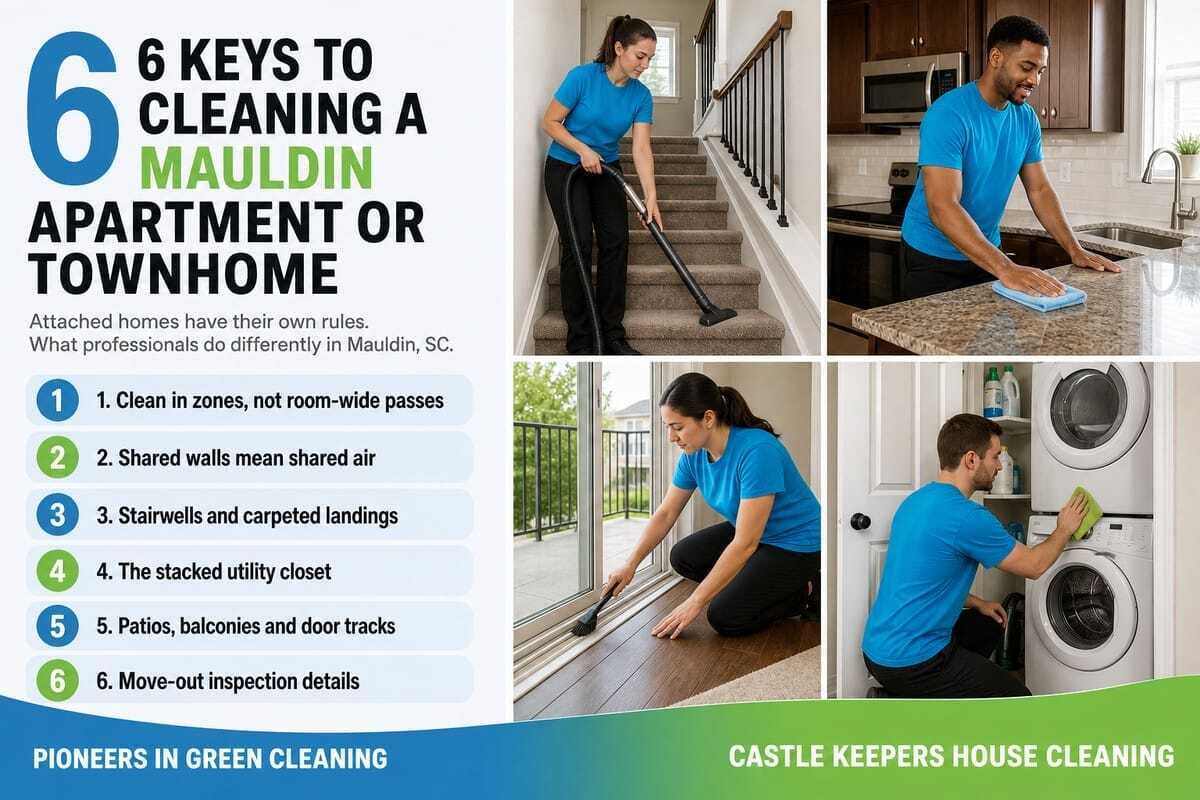
- Work in strict zones in a small unit: clean vertically, finish each zone completely before moving to avoid wasted walking.
- Shared walls move odors and particles; in Mauldin use the range hood, run exhaust fans, seal penetrations, and upgrade HVAC filters.
- Stairwells and carpeted landings bear concentrated traffic; vacuum risers, clean seams with a crevice tool, work top down, wipe handrails weekly.
- Quarterly inspect the stacked utility closet: clear the dryer vent, check the condensate pan, and clean behind and under the washer to prevent leaks.
Mauldin is one of the few places in the Upstate where you can live in a townhome off East Butler Road, walk to the Mauldin Cultural Center, and still be at work in Greenville in fifteen minutes. That convenience is exactly why so much of Mauldin’s housing is attached — apartments, condos, and townhome communities rather than detached houses on half-acre lots.
Cleaning an attached home is genuinely different from cleaning a standalone house, and most cleaning advice quietly assumes the latter. Apartment cleaning in Mauldin, SC comes with its own set of problems: shared walls, stacked plumbing, a utility closet instead of a laundry room, vertical stairwells that collect everything, and a lease that will eventually be inspected by someone with a checklist.
Here are the six things that actually matter in a Mauldin apartment or townhome, in the order we address them.
1. Small Square Footage Changes the Sequence, Not the Standard
In a 1,100-square-foot townhome, everything is closer together, which sounds easier and often is not. There is nowhere to stage furniture, one bathroom instead of three, and a kitchen where the stove, sink, and dishwasher are all within one arm’s reach — so grease, food soil, and detergent residue all land in the same small zone.
The professional approach is to work in strict zones and finish each one completely before moving on, rather than doing all the dusting in the whole unit and then all the wiping. In a compact space, walking back and forth is most of the wasted time. We also clean vertically: upper cabinet faces, then counters, then cabinet kick plates, then floor — because in a small kitchen, gravity does more redistributing than in a large one.
Small does not mean fast, either. Density of use is what drives how dirty a home gets, not its size. Two adults and a dog in a two-bedroom apartment generate the same soil load as they would in a four-bedroom house — it is just concentrated into fewer square feet.
2. Shared Walls Mean Shared Air
This is the part residents are most often surprised by. In attached construction, odors, humidity, and airborne particles move between units through shared wall cavities, unsealed plumbing penetrations, common attics, and the gap under a demising wall’s bottom plate. If your neighbor cooks with a lot of oil or smokes on a shared patio, some of that arrives in your unit no matter how clean your own home is.
What actually helps:
- Use the range hood every single time you cook, and check whether it vents outside or just recirculates. Many Mauldin apartment kitchens have recirculating hoods with a charcoal filter that nobody has changed in years — replacing it costs a few dollars and makes an immediate difference.
- Run the bathroom exhaust fan for 20 minutes after a shower, not just during it. Moisture is the raw material for the musty smell people blame on their neighbors.
- Check for open penetrations under the sink and behind the washer where pipes enter the wall. A little foam sealant or an escutcheon plate closes a direct air path between units.
- Upgrade the HVAC filter and change it on schedule. In a small unit with a small air handler, a loaded filter degrades air quality quickly.
The EPA’s guidance on indoor air quality is blunt about the hierarchy: remove the source, then ventilate, then filter. Masking odors with plug-ins adds pollutants without removing anything.
3. Stairwells and Carpeted Landings Are the Hardest-Working Surfaces
Almost every Mauldin townhome is two or three levels, which means a carpeted stair run takes the entire household’s foot traffic in a strip about 30 inches wide. Carpet on stairs wears and soils several times faster than carpet in a bedroom, and vacuuming it is awkward enough that it gets skipped.
Technique matters more here than equipment:
- Vacuum the riser (the vertical face) as well as the tread. Most of the visible grime on stairs lives on the riser and the nose of the step, where shoes scuff.
- Use a crevice tool along the edge where carpet meets the stringer — that seam holds an astonishing amount of grit.
- Work top step down so you are not re-soiling finished treads.
- Blot spills on stairs immediately and work from the outside of the spot inward. Scrubbing outward on a stair tread spreads the stain into the traffic lane where it will be permanently visible.
- If the handrail is painted, wipe it every week. It is one of the highest-touch surfaces in an attached home and one of the least cleaned.
4. The Utility Closet Is a Maintenance Problem Disguised as a Storage Problem
In most Mauldin apartments and townhomes, the washer, dryer, water heater, and air handler are stacked into one closet, often on an upper floor. That arrangement is compact and completely unforgiving of neglect.
Three things to check quarterly:
- Dryer venting. Stacked closets frequently have long, kinked flexible duct runs. Lint accumulation is the single most common cause of dryer fires, and a restricted vent also dumps warm moist air into the closet. Pull the duct and clear it.
- The condensate drain pan. An upstairs air handler that overflows damages the ceiling below it — and in an attached home, possibly a neighbor’s ceiling. Look for standing water and clear the drain line.
- Behind and under the washer. Detergent drips, lint, and dust combine into a paste that holds moisture against the floor. This is where musty closet smells almost always originate.
5. Patios, Balconies, and Entry Doors Are Where Outside Comes In
Upstate summers deliver pollen in spring, heavy afternoon thunderstorms through the summer, and red clay that gets tracked in year-round. In an apartment, your front door often opens directly onto a shared breezeway or an exterior stair, so there is no mudroom buffer at all.
Red clay deserves a specific warning, because it behaves unlike ordinary dirt. Upstate clay is rich in iron oxide, and once it dries into carpet fiber or grout it stains rather than simply soiling. The fix is to let it dry completely, vacuum the dry particles out first, and only then treat what remains with a small amount of cleaner. Attacking wet clay with water and a brush drives the pigment deeper into the fiber and is how a footprint becomes a permanent orange shadow at the base of a stairwell.
The highest-return habits are unglamorous: a coarse mat outside and an absorbent mat inside, a shoes-off rule if the household will accept one, and sweeping the balcony or patio before it rains rather than after. Sliding-door tracks deserve specific attention — vacuum the track, then wipe with a damp cloth wrapped around a butter knife. A clogged track holds water against the frame and is a common source of both sticking doors and small interior leaks.
6. Move-Out Inspections Reward Detail, Not Effort
Whether you are in an apartment community or a leased townhome, the end-of-lease walkthrough is done against a list. Property managers consistently deduct for the same items, and none of them are the things tenants spend the most time on:
- Oven interior and the drip pan under the burners
- Refrigerator seals, drawers, and the shelf underneath the crisper
- Range hood filter and the greasy cabinet face above the stove
- Baseboards and the paint scuffs behind furniture
- Blind slats and window sill tracks
- Tub and shower caulk lines — discoloration in caulk is often mildew growth, not stain, and needs to be treated as such
- Light fixtures and burned-out bulbs
If you are cleaning your own move-out, work that list literally and photograph each area when you finish. If the deposit is large or the timeline is short, a professional move-out clean is usually cheaper than the deductions it prevents — and we will tell you honestly when your unit is already close enough that hiring us would not pay for itself.
Recurring Cleaning Makes More Sense in a Small Home, Not Less
There is a common assumption that professional cleaning is for large houses. In practice, attached homes benefit at least as much, because in a compact space there is no room for a mess to be out of sight and no spare weekend day to catch up when work gets busy.
For Mauldin residents, that usually looks like a bi-weekly visit covering kitchen, bathrooms, floors, and dusting, with the stairwell and utility closet worked into a rotation rather than done every time. Because every home we clean gets a home-specific detailed scope of work, those rotating items are written down instead of remembered — and because you get the same team on the same day, they already know which sliding door sticks and which cabinet face collects grease.
Castle Keepers has cleaned Upstate homes since 1994, and our team helped co-author the industry’s Healthy Cleaning Techniques certification manual. In an attached home where you share air with your neighbors, the green cleaning methods we use are not a marketing preference — they are the practical choice, because there is nowhere for harsh fumes to go.
Talk to Us About Your Mauldin Apartment or Townhome
We are glad to walk your unit, tell you what it realistically needs, and give you a straight number. Start with our apartment cleaning service details, then see local coverage on our Mauldin house cleaning page. We also serve nearby Simpsonville and Greenville.
Request a quote online or call our Greenville office at (864) 200-2550.
Share this article
Related Posts





A quick overview of the topics covered in this article.